Why South Korea Dominates Esports & Why India Can Learn
From government support and esports infrastructure to grassroots tournaments and publisher involvement, here's how South Korea built a world-leading esports ecosystem and Why India can learn from it.
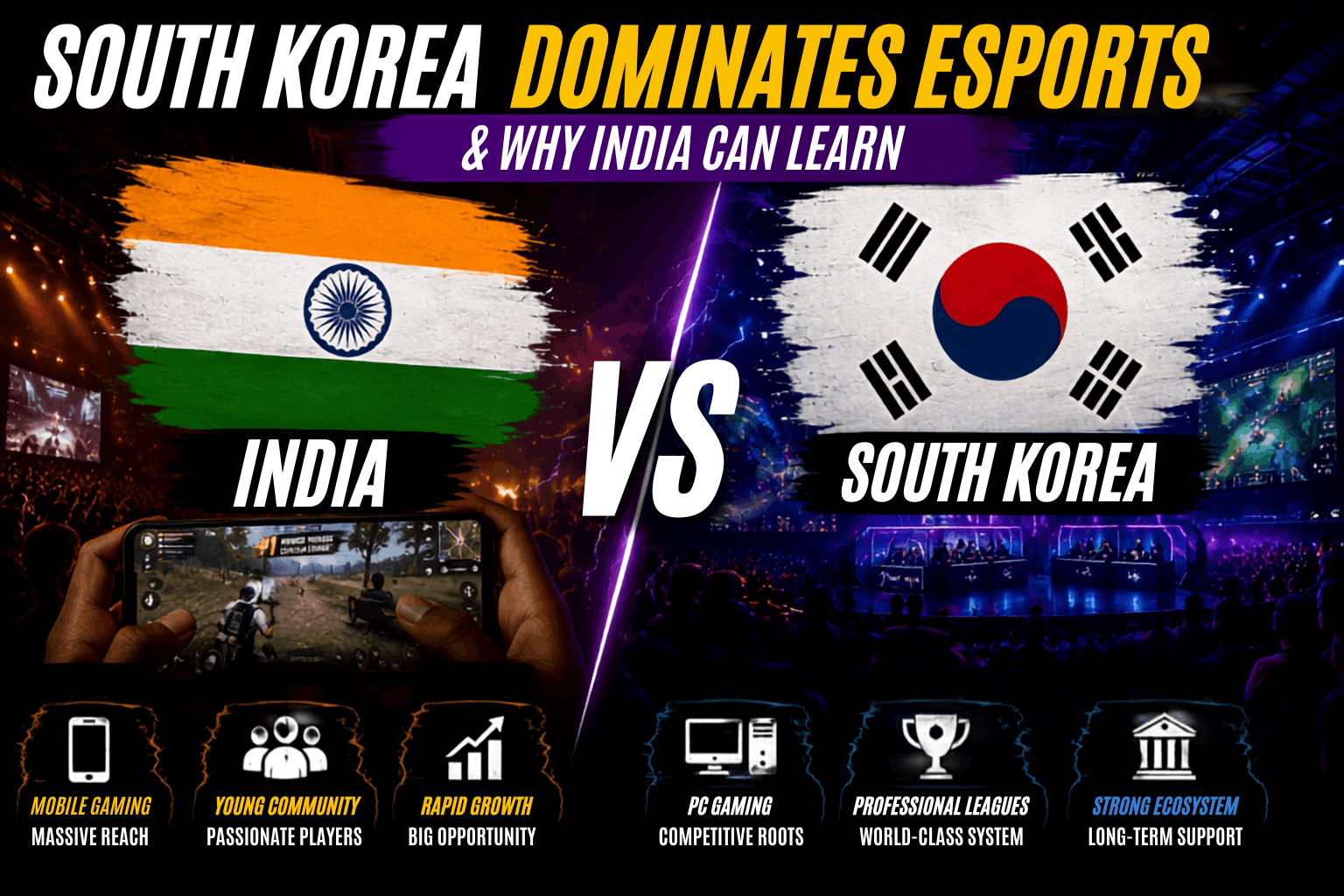
Why South Korea Dominates Esports & Why India Can Learn
Imagine This...
One country treats esports players like national sports stars.
The other has one of the fastest-growing gaming communities in the world.
Both countries love gaming.
Both have talented players.
Yet when it comes to building a world-class esports ecosystem, there's still a significant gap.
So why is South Korea considered one of the greatest esports nations while India is still developing its competitive ecosystem?
The answer isn't just better players or faster internet.
South Korea spent over 25 years building its esports industry through investment, infrastructure, education, and collaboration between the government, publishers, tournament organizers, and the gaming community.
India, meanwhile, has grown rapidly in recent years thanks to affordable smartphones, low-cost internet, and games like BGMI, VALORANT, Free Fire MAX, and Pokémon Unite.
Both countries followed different paths.
And that's exactly why there's so much India can learn from South Korea's journey.
Why Compare India and South Korea?
South Korea didn't just produce world champions—it helped define modern esports.
- Professional leagues
- Dedicated arenas
- Government support
- Corporate sponsorships
- Structured player development
These systems were built over decades.
India's growth has been very different.
Instead of PC cafés, its esports boom has been driven by mobile gaming, creators, affordable internet, and a massive young audience.
The goal isn't to copy South Korea.
It's to understand what worked there and adapt those lessons for India's unique ecosystem.
Two Different Journeys
| Category | 🇮🇳 India | 🇰🇷 South Korea |
|---|---|---|
| Major Growth | After 2018 | Late 1990s |
| Dominant Platform | Mobile Gaming | PC Gaming |
| Government Ecosystem | Developing | Highly Structured |
| International Reputation | Emerging Market | Global Leader |
| Professional Leagues | Growing | Well Established |
💡 Quick Insight
South Korea built its esports ecosystem around PC gaming, while India's growth has been powered by mobile esports. Both models reflect the strengths of their respective markets.
How South Korea Became an Esports Powerhouse
South Korea's esports journey began in the late 1990s.
After the 1997 Asian Financial Crisis, the country invested heavily in broadband infrastructure.
This led to the rise of PC Bangs, where gamers gathered to compete and improve.
Then came StarCraft.
The game transformed competitive gaming into a national phenomenon.
- Local tournaments became professional leagues.
- Esports appeared on television.
- Sponsors invested.
- Players became celebrities.
Gaming was no longer just entertainment—it became a respected profession.
India's Mobile-First Revolution
India's esports journey followed a completely different path.
Instead of high-end gaming PCs, the industry grew through affordable smartphones and low-cost 4G internet.
Games like PUBG Mobile, BGMI, Free Fire MAX, VALORANT, and Call of Duty: Mobile introduced millions of players to competitive gaming.
This accessibility became India's biggest strength.
Today, almost anyone with a smartphone can compete, stream, and dream of becoming a professional player.
🎯 Universal Esports Insight
India's biggest opportunity isn't copying South Korea's PC-focused model. It's building a unique ecosystem that combines mobile esports, grassroots tournaments, creator communities, and esports education.
What's Next?
South Korea's rise wasn't driven by talented players alone.
Government policies, organizations like KeSPA, and long-term planning played a huge role in shaping its esports ecosystem.
In Part 2, we'll explore how government support helped South Korea become a global esports leader—and Why India can learn from that approach.
➡️ Continue to Part 2