PM Modi at IMC 2026: Mobile Phones Are Now Gaming Consoles. What It Means for Indian Esports
At IMC 2026, PM Modi said 50 crore+ Indians are in the gaming ecosystem and youth now compete in esports. No new policy was announced. Here is what it means.
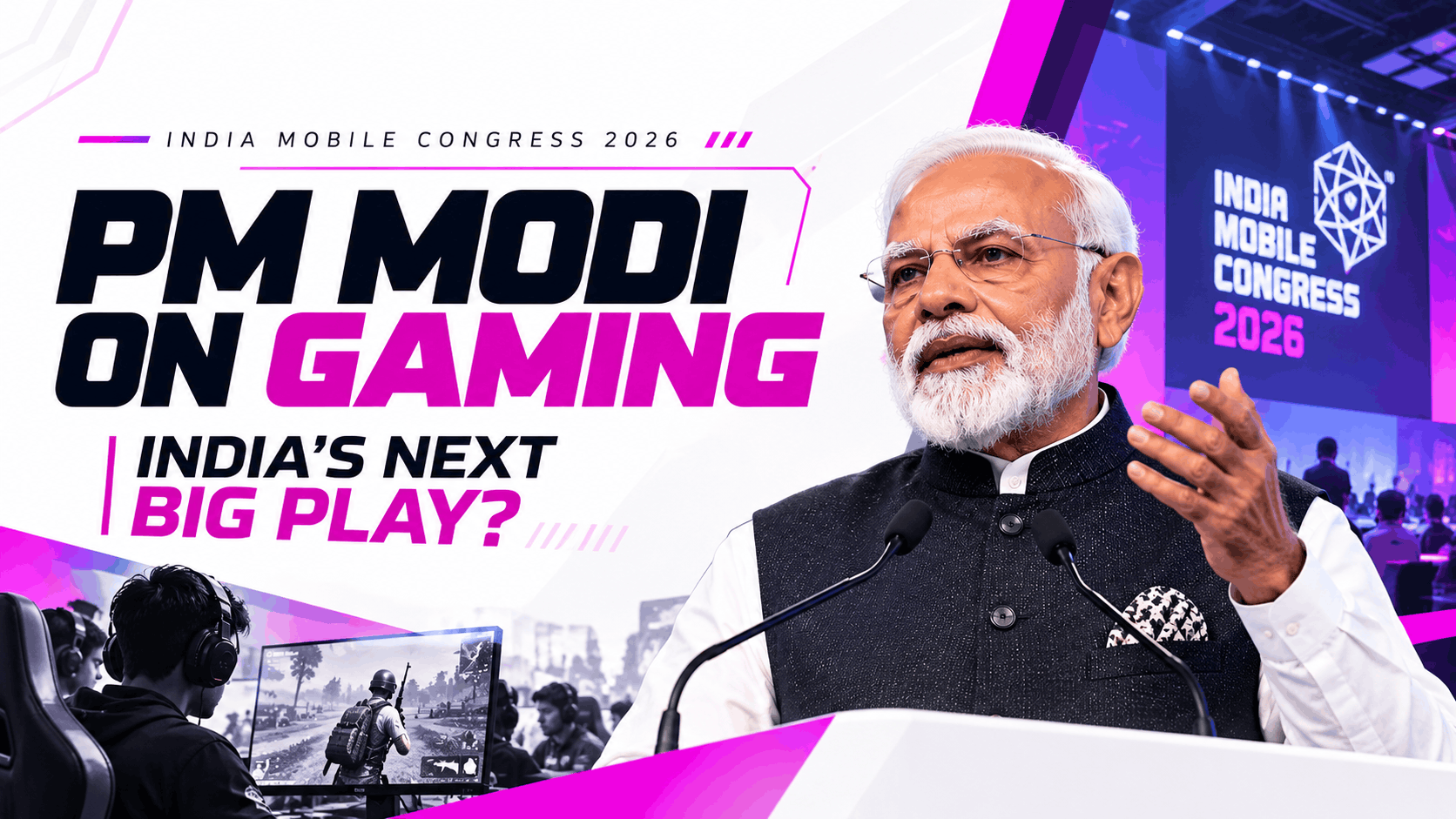
Prime Minister Narendra Modi put gaming and esports into his inaugural address at the 10th India Mobile Congress (IMC) on 8 October 2026. He used them as one of his main examples of how cheap data and mobile connectivity have changed India. The remarks were short and did not come with any new scheme, fund or rule. Still, it matters to the industry when the Prime Minister mentions esports by name on one of India's biggest technology stages.
Here is what he said, what it does and does not change, and what Indian organisers, colleges, teams and sponsors can take from it.
What PM Modi said at IMC 2026
Fact. According to the official summary published by the Prime Minister's Office, Modi inaugurated the 10th edition of IMC at Yashobhoomi in New Delhi on 8 October. A PIB release on the event says IMC 2026 runs from 7 to 10 October under the theme "Scale Without Boundaries".
The PMO summary records three points on gaming:
- More than 50 crore people are now part of the gaming ecosystem, and many of them are young people from Tier-2 and Tier-3 cities.
- These young people are doing more than playing. They are competing in esports, creating content and building businesses.
- His line on the device itself: "the mobile phone in India is today a gaming console as well and has also become a studio of creation."
The speech was given in Hindi, and the quotes here come from the PMO's official English rendering. Media reports translated the same line slightly differently. Moneycontrol's report, for example, uses the wording "a gaming console as well as a content creation studio".
He linked gaming to a wider argument. Towers, optical fibre and cheap data, he said, created "new sectors in the economy". He also said the mobile phone "has also democratized content creation in India". In the same speech, he said 5G now runs from more than 5.5 lakh base stations and reaches every district. He also called for a global framework to deal with deepfakes and said phone and network security is a priority.
What the speech did not do
Fact. No new gaming policy, esports programme, fund or regulatory change was announced. Outlook Respawn's coverage says the same: the speech did not announce a new gaming fund or esports programme. Instead, it placed gaming inside a larger story about connectivity and the creator economy.
The "over 50 crore" figure is the number the Prime Minister cited. It is not a new official survey, and the speech did not say how it was measured or how much of it is competitive esports versus casual play.
The policy context: the Online Gaming Act and Rules
Fact. The remarks come on top of a legal framework that is already in force. A PIB explainer from April 2026 makes these points:
- Parliament enacted the Promotion and Regulation of Online Gaming (PROG) Act in August 2025.
- The Act bans online money games. It "provides recognition to e-sports and online social games".
- The Promotion and Regulation of Online Gaming Rules, 2026 came into force on 1 May 2026.
- The Rules set up the Online Gaming Authority of India as an attached office of the Ministry of Electronics and IT.
- The Rules create a registration regime for e-sports.
- Online money games are not eligible for recognition or registration as e-sports under the National Sports Governance Act, 2025.
So the IMC speech is not new policy. It is the Prime Minister publicly backing a direction the government has already written into law: esports and social gaming on one side, real-money gaming on the other.
Why it matters
Analysis. For an industry that often has to explain itself to parents, college administrators and brand managers, a few things help:
- Legitimacy. When the head of government names esports alongside content creation and entrepreneurship, it reinforces the separation the PROG Act already draws between esports and gambling.
- Where the players are. The Tier-2 and Tier-3 emphasis matches what grassroots organisers see on the ground: much of India's competitive talent pipeline is outside the metros and plays on phones.
- Mobile-first is the mainstream. The "gaming console" line treats mobile as the main platform for Indian gaming. That matters for mobile titles such as BGMI, which already sit at the centre of many Indian tournaments.
None of this changes prize pools, visas, tax treatment or tournament licensing tomorrow. Those questions sit with the Rules, the ministries and the publishers.
What it means for the Indian esports ecosystem
Analysis.
- Tournament organisers can point to the PROG Act and to statements like this one when they talk to venues, colleges and local authorities. They should also make sure their formats have no entry-fee-for-cash-prize structures that could look like money gaming.
- Colleges and universities have a clearer case for treating esports as a recognised competitive activity: clubs, inter-college leagues and structured events, with fair-play and age-appropriate safeguards.
- Teams and players should expect more attention, and more scrutiny, as esports registration under the Rules develops. Professional conduct, clean contracts and integrity policies will matter more.
- Sponsors and brands get more reputational comfort around esports. They should still check that any partner or platform is not an online money game, because promoting one is prohibited under the Act.
- Creators and casters were directly part of the message. Gaming content creation was named next to competing and building businesses.
What comes next
Uncertain. The speech gives no timeline for new esports measures, and none should be assumed. Things worth watching:
- How the Online Gaming Authority of India handles esports registrations in practice.
- Any guidance from the Ministry of Youth Affairs and Sports on recognising esports.
- Whether IMC-linked announcements or later events turn this rhetoric into concrete programmes.
Universal Esports will cover verified developments as they happen.
Frequently asked questions
Did PM Modi announce a new esports policy at IMC 2026?
No. He spoke about gaming and esports as examples of growth driven by mobile connectivity. No new scheme, fund or rule was announced.
What exactly did he say about gaming?
According to the PMO's English summary, he said more than 50 crore people are part of the gaming ecosystem, mostly youth from Tier-2 and Tier-3 cities, and that they are competing in esports, creating content and building businesses. He also said the mobile phone in India "is today a gaming console as well and has also become a studio of creation."
Is esports legally recognised in India?
The Promotion and Regulation of Online Gaming Act, 2025 provides recognition to e-sports and bans online money games, according to PIB. Its Rules came into force on 1 May 2026 and set up a registration regime for e-sports.
Does this affect real-money gaming platforms?
The speech did not address them. Under the PROG Act, online money games are prohibited and cannot be recognised or registered as e-sports.
Sources
- Prime Minister's Office: PM inaugurates 10th edition of India Mobile Congress (8 Oct 2026)
- PIB: India Mobile Congress 2026 commences at Yashobhoomi
- PIB: Enabling safe and responsible gaming under the Online Gaming Rules, 2026 (30 Apr 2026)
- Moneycontrol: Every smartphone in India is now a gaming console and creator studio, says PM Modi
- Outlook Respawn: PM Modi highlights India's gaming ecosystem