Free Fire MAX India Cup Fall 2026 Sees 125% Viewership Growth: What It Means for Indian Esports
The Free Fire MAX India Cup Fall 2026 attracted 289,702 peak viewers and 3.66 million hours watched. Here's what its 125% viewership growth means for Indian esports.
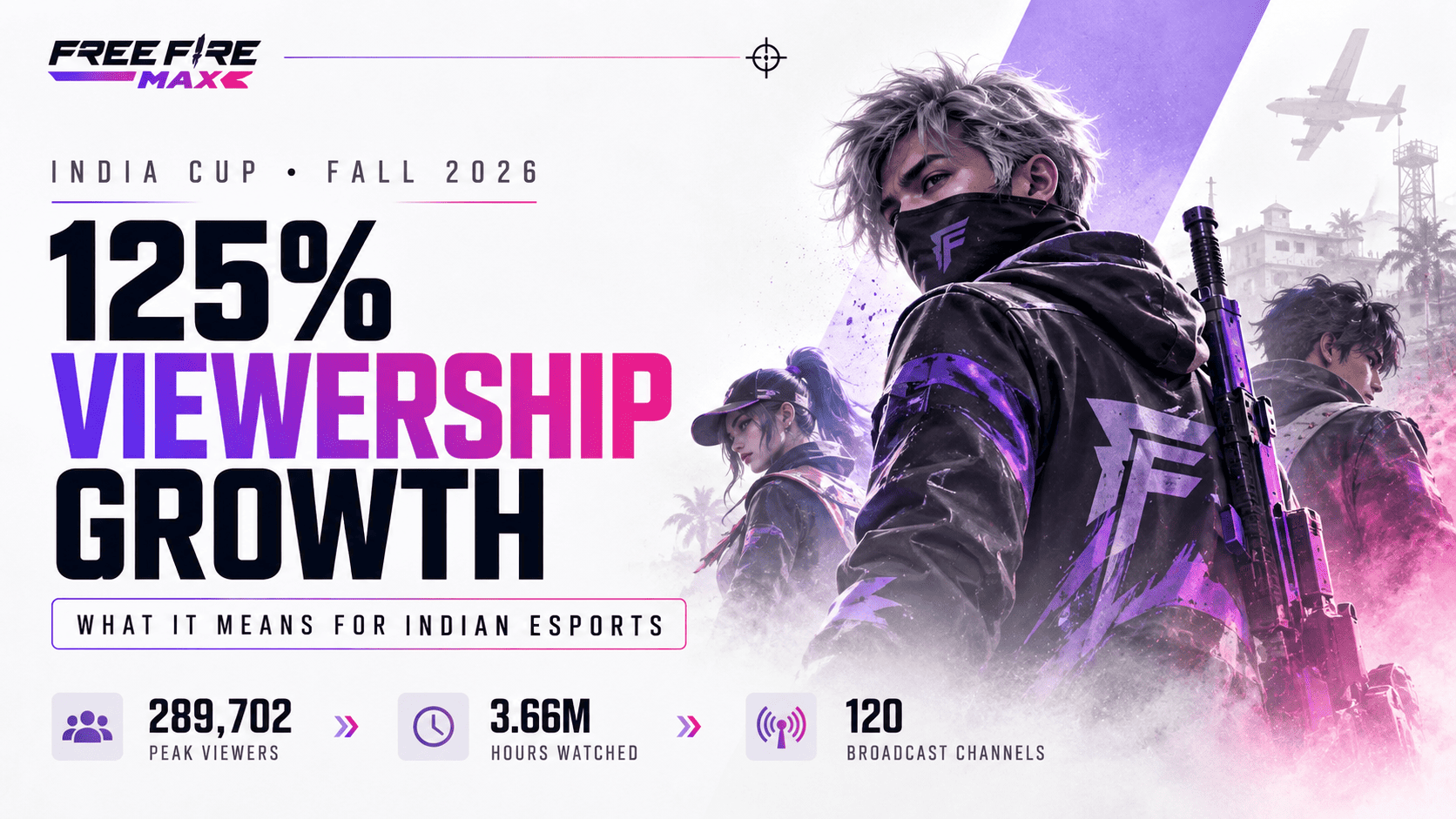
Free Fire MAX India Cup Fall 2026 Sees 125% Viewership Growth: What It Means for Indian Esports
The Free Fire MAX India Cup Fall 2026 has delivered one of the strongest signs yet that India's mobile esports audience is continuing to grow — and the biggest story may not be the tournament itself, but how fans watched it.
The tournament reached 289,702 peak concurrent viewers and generated approximately 3.66 million hours watched across its broadcasts.
Compared with the Spring edition, peak viewership increased by 125.3%, while total watch time grew by 111.4%.
But there is another number that may be even more important for the future of Indian esports:
The number of unique broadcasting channels increased from 43 to 120.
That nearly threefold increase shows how esports is moving beyond the traditional model of one official broadcast and toward a much broader creator- and community-driven ecosystem.
---
Free Fire MAX India Cup Fall 2026: The Numbers
The Fall edition of the Free Fire MAX India Cup (FFMIC) concluded on September 27, 2026, with Team Apex Gaming taking the championship.
According to Esports Charts, the tournament recorded:
| Metric | FFMIC Fall 2026 |
|---|---:|
| Peak Viewers | 289,702 |
| Hours Watched | 3.66 million |
| Broadcasting Channels | 120 |
| Peak Viewership Growth vs Spring | +125.3% |
| Hours Watched Growth vs Spring | +111.4% |
| Prize Pool | $103,554 |
| Tournament Winner | Team Apex Gaming |
The tournament's most-watched moment came during Round 9 of the Champion Rush phase, when 289,702 viewers were watching concurrently.
Team Apex Gaming secured the championship after winning the decisive Booyah and finishing at the top of the Champion Rush standings.
The result also put the tournament among the most-watched Free Fire competitions of 2026.
---
The 125% Growth Is More Important Than the Headline
At first glance, 125.3% growth in peak viewership sounds like just another impressive esports statistic.
It isn't.
A 125% increase in peak viewers means the tournament more than doubled its previous Spring peak.
At the same time, total watch time increased by 111.4% to 3.66 million hours.
This is important because peak viewers and hours watched measure different things.
Peak viewers tell us how large the audience became at the biggest moment.
Hours watched provide a better indication of how much total attention the tournament generated throughout its broadcast.
When both numbers rise substantially at the same time, it suggests that the growth was not simply caused by one viral moment.
The overall tournament attracted significantly more attention.
---
The Biggest Change: 43 Broadcast Channels Became 120
This may be the most interesting part of the entire story.
The Fall edition was broadcast across 120 unique channels, compared with only 43 during the Spring edition.
That's almost a threefold increase in distribution.
The tournament was no longer dependent on a single official broadcast.
Viewers could discover the competition through:
- Official broadcasts
- Community casters
- Gaming creators
- YouTube
- Kick
- TikTok
- Multistreaming channels
This changes the way an esports tournament can grow.
Instead of asking:
"How many people will come to our official broadcast?"
Organizers can start asking:
"How many communities can help us distribute this tournament?"
That is a much more powerful question.
---
Community Casting Is Becoming a Serious Distribution Channel
One of the most important developments around FFMIC Fall 2026 was the increasing contribution of community casters.
According to Esports Charts, community casting contributed more to the tournament's total watch time than the official channels.
That is a significant development for esports.
Traditional sports generally have a small number of official broadcasters.
Esports can work differently.
A single tournament can be watched through dozens — or even hundreds — of different creators and community channels.
Every creator brings their own:
- Audience
- Language
- Personality
- Community
- Commentary style
- Social-media reach
Instead of competing with the official broadcast, these creators can become an additional distribution network for the tournament.
---
Why This Matters for Indian Esports
India has one of the world's largest gaming audiences.
But having millions of gamers does not automatically create a strong esports ecosystem.
A successful esports ecosystem needs several layers:
Players → Teams → Tournaments → Creators → Broadcasters → Sponsors → Fans
The FFMIC Fall numbers show that the creator and broadcasting layer is becoming increasingly important.
When more creators participate in tournament coverage, the tournament gains more entry points for viewers.
Someone might discover the competition through a YouTube creator.
Another viewer might find it through TikTok.
A Free Fire community might watch a local-language caster.
A competitive player might follow a team stream.
The same tournament can therefore reach completely different audiences without requiring every viewer to follow the official channel.
---
The Opportunity for Grassroots and College Esports
This trend isn't limited to major national tournaments.
It could be even more important for grassroots esports.
Consider a college tournament with:
- 64 teams
- 300+ players
- 5,000 students
- 10 gaming creators
- 2–3 casters
- Multiple social-media pages
The organizer doesn't necessarily need to build one huge audience from zero.
Instead, the tournament can connect multiple existing communities.
For example:
Official Broadcast
→ Main tournament stream
Caster 1
→ Hindi commentary
Caster 2
→ Regional-language commentary
Creator 1
→ Team-focused watchalong
Creator 2
→ Community reaction
→ Highlights and short-form clips
YouTube Shorts
→ Best plays
Website
→ Live standings and player statistics
The result is a much larger digital footprint around the same tournament.
---
This Could Change How Tournament Organizers Think About Broadcasting
For years, esports broadcasting has often been treated as a production problem.
Organizers ask:
"How do we produce a professional stream?"
That question is important.
But there is another question that is becoming equally important:
"How do we distribute that stream to as many relevant communities as possible?"
Production creates the content.
Distribution creates the audience.
The strongest esports tournaments need both.
A tournament can have an expensive production setup, professional observers and excellent graphics.
But if only a small audience sees it, the commercial value remains limited.
On the other hand, a well-distributed tournament can reach viewers through multiple communities and platforms.
The FFMIC Fall numbers provide a strong example of this model.
---
What Sponsors Should Pay Attention To
This trend also matters to brands entering esports.
Sponsors are not only buying logo placement anymore.
They are increasingly interested in:
- Audience reach
- Watch time
- Social-media impressions
- Creator integrations
- Content volume
- Community engagement
- Player visibility
- Regional reach
A tournament distributed across 120 channels can potentially create significantly more touchpoints for a sponsor than a tournament relying on one broadcast.
For brands, that means an esports sponsorship package can evolve from:
"Your logo will appear on our stream."
to:
"Your brand will appear across a network of broadcasts, creators, social content and tournament experiences."
That is a much stronger commercial proposition.
---
What Indian Tournament Organizers Can Learn From FFMIC
There are several lessons that smaller organizers can apply immediately.
1. Build a Creator Network
Don't wait until tournament day to find casters and creators.
Build relationships with creators before the tournament.
Create a network of people who regularly cover your competitions.
---
2. Make Co-Streaming Easy
Provide creators with everything they need:
- Stream links
- Match schedules
- Team information
- Player information
- Tournament rules
- Branding assets
- Match graphics
- Live statistics
- Social-media assets
The easier you make co-streaming, the more likely creators are to participate.
---
3. Think Beyond YouTube
YouTube remains extremely important for Indian esports.
But esports audiences are increasingly distributed across multiple platforms.
Depending on the tournament and audience, organizers should evaluate:
- YouTube
- TikTok where available
- Kick
- Other creator platforms
The objective should not simply be to choose a platform.
It should be to meet viewers where they already spend their time.
---
4. Turn Every Match Into Content
A tournament shouldn't produce only one livestream.
One match can create:
- Full broadcast
- Highlights
- Best kills
- Player interviews
- MVP clips
- Team stories
- Short-form videos
- Statistics
- Memes
- Behind-the-scenes content
The match is the source.
The content ecosystem is the product.
---
5. Give Players Something to Follow
Viewers don't only follow tournaments.
They follow stories.
A strong tournament should create identifiable:
- Players
- Teams
- Rivalries
- Rankings
- MVP races
- Statistics
- Records
- Storylines
This is particularly important for grassroots esports.
If a player performs exceptionally well in a college tournament, that performance should become part of their esports identity.
---
The Future of Indian Esports May Be More Community-Driven
The biggest lesson from FFMIC Fall 2026 may not be that Free Fire has a large audience.
We already knew that.
The more interesting lesson is that the audience can grow dramatically when distribution grows with it.
The jump from 43 broadcasting channels to 120 demonstrates the potential of a decentralized esports media ecosystem.
Instead of one broadcaster owning the entire viewing experience, hundreds of creators can participate in building the audience.
That model could become increasingly important as India's esports ecosystem expands.
---
What This Means for Universal Esports
At Universal Esports, we believe the next phase of Indian esports will not be built only around bigger prize pools.
It will be built around better infrastructure, better tournament experiences and stronger communities.
For college and grassroots esports, tournament organizers need to think beyond simply conducting matches.
A modern tournament should provide:
- Tournament registration
- Team management
- Player profiles
- Live schedules
- Live standings
- Player statistics
- Match results
- Broadcast integration
- Creator partnerships
- Social-media content
- Sponsor visibility
The goal should be to turn a tournament from a single event into a digital ecosystem.
And that is where the growth opportunity lies.
---
The Bigger Picture
The Free Fire MAX India Cup Fall 2026 recorded 289,702 peak viewers and 3.66 million hours watched, with peak viewership increasing by 125.3% compared with the Spring edition.
But the most interesting number may be the increase from 43 to 120 broadcasting channels.
It shows that the future of esports broadcasting may not belong exclusively to official tournament channels.
It may belong to the entire community surrounding the tournament.
For India, that is a particularly important development.
The country already has the players.
It has the teams.
It has the gaming audience.
The next challenge is building the infrastructure that connects all of them.
And if the growth of FFMIC Fall 2026 is any indication, Indian esports is moving in that direction.
---
Frequently Asked Questions
How many viewers watched the Free Fire MAX India Cup Fall 2026?
The tournament reached 289,702 peak concurrent viewers during Round 9 of the Champion Rush phase.
How much watch time did FFMIC Fall 2026 generate?
The tournament generated approximately 3.66 million hours watched across its broadcasts.
How much did FFMIC Fall 2026 viewership grow?
Peak viewership increased by 125.3% compared with the Spring edition, while total hours watched increased by 111.4%.
How many channels broadcast FFMIC Fall 2026?
The number of unique broadcasting channels increased from 43 in the Spring edition to 120 in the Fall edition.
Which team won Free Fire MAX India Cup Fall 2026?
Team Apex Gaming won the tournament after topping the Champion Rush standings.
Why is community casting important for esports?
Community casting allows tournaments to reach audiences through independent creators, different languages, platforms and established gaming communities. It can significantly expand tournament distribution beyond the official broadcast.
---
Final Takeaway
Indian esports doesn't only need more tournaments. It needs more ways for people to discover, watch and participate in those tournaments.
The Free Fire MAX India Cup Fall 2026 provides a strong example of what happens when competitive esports, creators and multiple distribution channels come together.
The next opportunity for Indian tournament organizers is clear:
Don't just organize the tournament. Build the ecosystem around it.
---
Sources
- Esports Charts — FFMIC 2026 Fall: 125% More Viewers Than Spring Edition
- Esports Charts — Free Fire MAX India Cup 2026 Fall Statistics
- Free Fire Esports India — Official FFMIC 2026 broadcasts
Data and viewership figures referenced in this article are based on publicly available tournament and esports analytics data. Viewership figures represent tracked broadcasts and may not represent every viewer across every platform.